For government job aspirants in Assam, two prominent recruitment gateways dominate the conversation: the Assam Direct Recruitment Examination (ADRE) conducted by SLRC, and Banking Examinations (IBPS PO/Clerk, SBI PO/Clerk, RRB) conducted on a national scale.
Both avenues offer security, competitive remuneration, and prestige. However, aspirants often face a dilemma: Can I prepare for both exams simultaneously? How different are the syllabi, and which path offers a faster route to selection?
This comprehensive analysis breaks down the core distinctions in exam format, syllabus weightage, question difficulty, and a unified preparation blueprint developed by Scholar Academy of Learning.
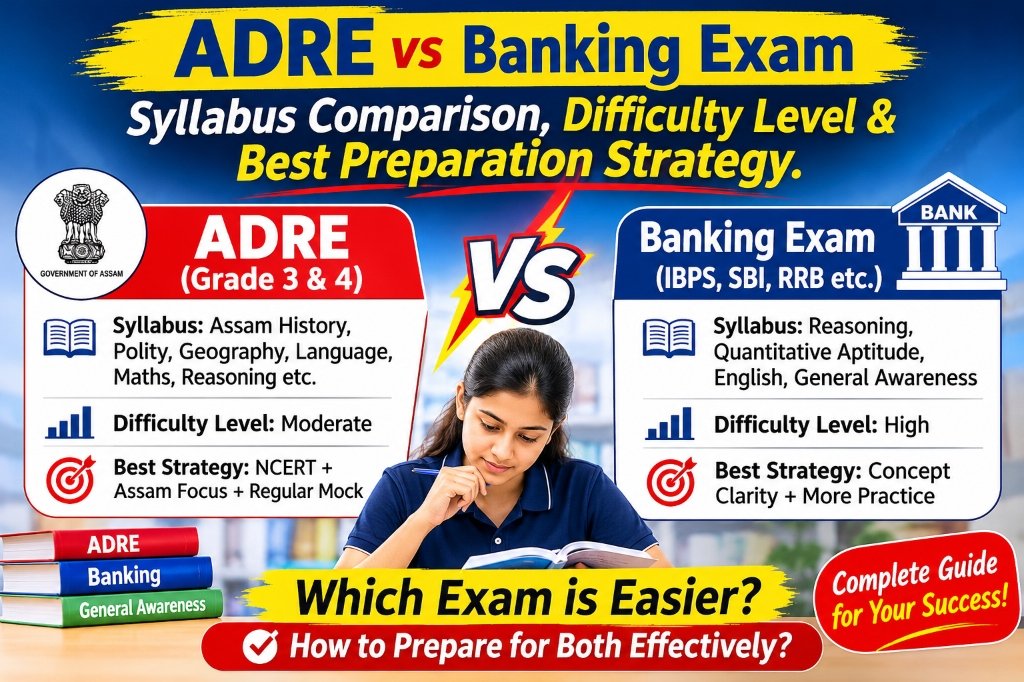
1. Quick Overview: ADRE vs Banking
| Parameter | ADRE (Assam Direct Recruitment) | Banking Exams (IBPS / SBI / RRB) |
|---|---|---|
| Recruitment Authority | State Level Recruitment Commission (SLRC Assam) | IBPS, State Bank of India, RBI |
| Exam Medium | Offline OMR Sheet (Pen & Paper) | Online Computer-Based Test (CBT) |
| Regional Weightage | Heavy focus on Assam History, Geography & Culture | Zero state-specific GK; National Banking/Financial Awareness |
| Time Constraint | Moderate (120 minutes for 100–150 questions) | Extreme (Strict 20-minute sectional limits in Prelims) |
| Negative Marking | Applicable (0.25 to 0.50 per wrong response) | Applicable (0.25 marks deducted per wrong answer) |
| Recruitment Frequency | Driven by state recruitment phases (ADRE 1.0, 2.0, 3.0) | Annual fixed examination calendar (Predictable cycle) |
2. Section-by-Section Syllabus Comparison
While both exams evaluate aptitude, English, and general knowledge, the underlying nature of the questions differs significantly:
A. Quantitative Aptitude & Mathematics
- ADRE: Questions align with secondary school standards (Class 8–10 level). The focus rests on fundamental arithmetic: percentage calculations, simple and compound interest, ratios, basic geometry, and mensuration. Formulas are direct and concept-driven.
- Banking: Math in banking requires extreme calculation velocity. In addition to arithmetic, aspirants face complex Data Interpretation (DI) sets, missing/wrong number series, approximation, and quadratic equations. Mental math shortcuts and Vedic calculation methods are mandatory to clear sectional cut-offs.
B. Reasoning & Mental Ability
- ADRE: Features foundational, logic-based puzzles: series completion, direction sensing, analogical relationships, simple coding-decoding, and basic Venn diagrams.
- Banking: Highly analytical and multi-layered. Expect multi-variable circular and linear seating arrangements, floor puzzles, reverse syllogisms, and coded inequalities. Banking reasoning evaluates reading speed and spatial problem-solving under severe pressure.
C. General Awareness: Regional vs Financial Focus
- ADRE: Success is virtually impossible without extensive command over Assam General Studies. Major topics include the Ahom dynasty, Koch and Chutiya history, Brahmaputra river basin geography, wildlife reserves, state budget allocations, and flagship welfare schemes.
- Banking: Demands zero regional state history. Instead, the paper focuses on national and international financial news, RBI circulars, monetary policy rates, fiscal deficit metrics, and statutory banking terms.
D. English Language
- ADRE: Basic to intermediate functional grammar, identifying misspelled words, prepositions, active/passive voice transformations, and basic passage comprehension.
- Banking: Advanced contextual English. High-level reading comprehensions based on editorial and financial texts, para-jumbles, sentence connectors, and error-spotting framed in corporate English.
3. Difficulty Level: Speed vs Knowledge
The fundamental difference lies in how marks are scored:
- ADRE is a Knowledge-Driven Exam: If you have thoroughly memorized Assam’s socio-historical facts and understand fundamental math formulas, you have sufficient time to read and solve the questions accurately during the 2-hour window.
- Banking is a Speed & Reflex-Driven Exam: Even with total concept clarity, you must solve 100 questions within 60 minutes during Prelims—split into strict 20-minute windows for each section. An uncalculated hesitation on a single reasoning puzzle can end an attempt.
4. The Dual Preparation Strategy: Can You Clear Both?
Preparing for both exams simultaneously is completely feasible with an integrated top-down strategy:
- Leverage the High Banking Aptitude Benchmark: Preparing Quantitative Aptitude and Logical Reasoning at the banking standard builds calculation reflexes that make ADRE math and reasoning feel straightforward.
- Dedicate a Separate Daily Window for Assam GS: Set aside 90 minutes each day strictly for Assam History, Geography, and current state affairs. Since banking does not cover state GK, this dedicated slot preserves your competitiveness in state recruitment.
- Practice Dual-Format Testing: Alternate between offline OMR sheet practice for ADRE and online computer-based simulators for banking exam patterns.
5. Evaluate Your Preparation on PYQscore
Accurate test series practice separates serious candidates from the crowd.
At PYQscore (www.pyqscore.in) and the PYQScore Mobile App, candidates can practice both recruitment formats:
- Authentic CBT Banking Mocks: Practice IBPS and SBI full-length tests with live timers, negative scoring, and sectional speed analytics.
- ADRE Test Series & Solved PYQs: Access authentic previous year question papers and model OMR tests for Grade 3 and Grade 4 recruitments.
- State-Wide Benchmarking: View your percentile rank across candidates throughout Assam.
👉 Practice tests online today at www.pyqscore.in or download the PYQScore App on Google Play.
Classroom Mentorship at Scholar Academy of Learning (Dibrugarh & Tezpur)
For aspirants seeking structured physical guidance, specialized faculty shortcuts, and daily evaluation in Upper and Central Assam:
Scholar Academy of Learning provides comprehensive coaching for both banking recruitments and Assam state direct recruitments across our dedicated branches:
- Dibrugarh Branch: Centrally located at Lachit Nagar, Dibrugarh, Assam, featuring modern interactive smart panels, comprehensive bilingual study modules, and structured doubt-clearing sessions.
- Tezpur Branch: Bringing premier competitive classroom coaching, test labs, and experienced faculty support directly to students in and around Tezpur, Assam (Murha Teteli).
- Integrated Curriculum: Specialized foundation batches covering banking calculation tricks alongside dedicated Assam GS capsules for state exams.
- Admissions & Batch Enquiry: Contact your nearest center or call +91-9508602878 / +91-8638757905
- Official Website: salcoaching.in
Frequently Asked Questions (FAQs)
Q1. Which exam should a beginner target first: ADRE or Banking?
If you have a strong command of general studies, state culture, and basic mathematics, ADRE offers an accessible starting point. If you possess quick calculation instincts, logical reasoning clarity, and aim for an annually scheduled recruitment calendar, banking exams provide a predictable and recurring path.
Q2. Can final-year graduation students apply for both recruitments?
Yes. Final-year students are eligible to sit for banking preliminary rounds (subject to official notification cut-off dates) and can prepare for upcoming ADRE Grade 3 recruitment cycles.
Q3. How does Scholar Academy of Learning help dual-preparation students?
Our classroom curriculum at Dibrugarh and Tezpur is structured modularly: students master high-speed aptitude and reasoning suitable for national banking exams, while simultaneously receiving structured state General Studies modules designed specifically for SLRC ADRE syllabi.

Scholar Academy of Learning
Assam's trusted competitive exam institute with classroom campuses in Dibrugarh (Lachit Nagar) & Tezpur (Murha Teteli). Offering integrated coaching for ADRE, Banking (IBPS/SBI), Assam Police, APSC, SSC & TET with PYQscore.in test series.